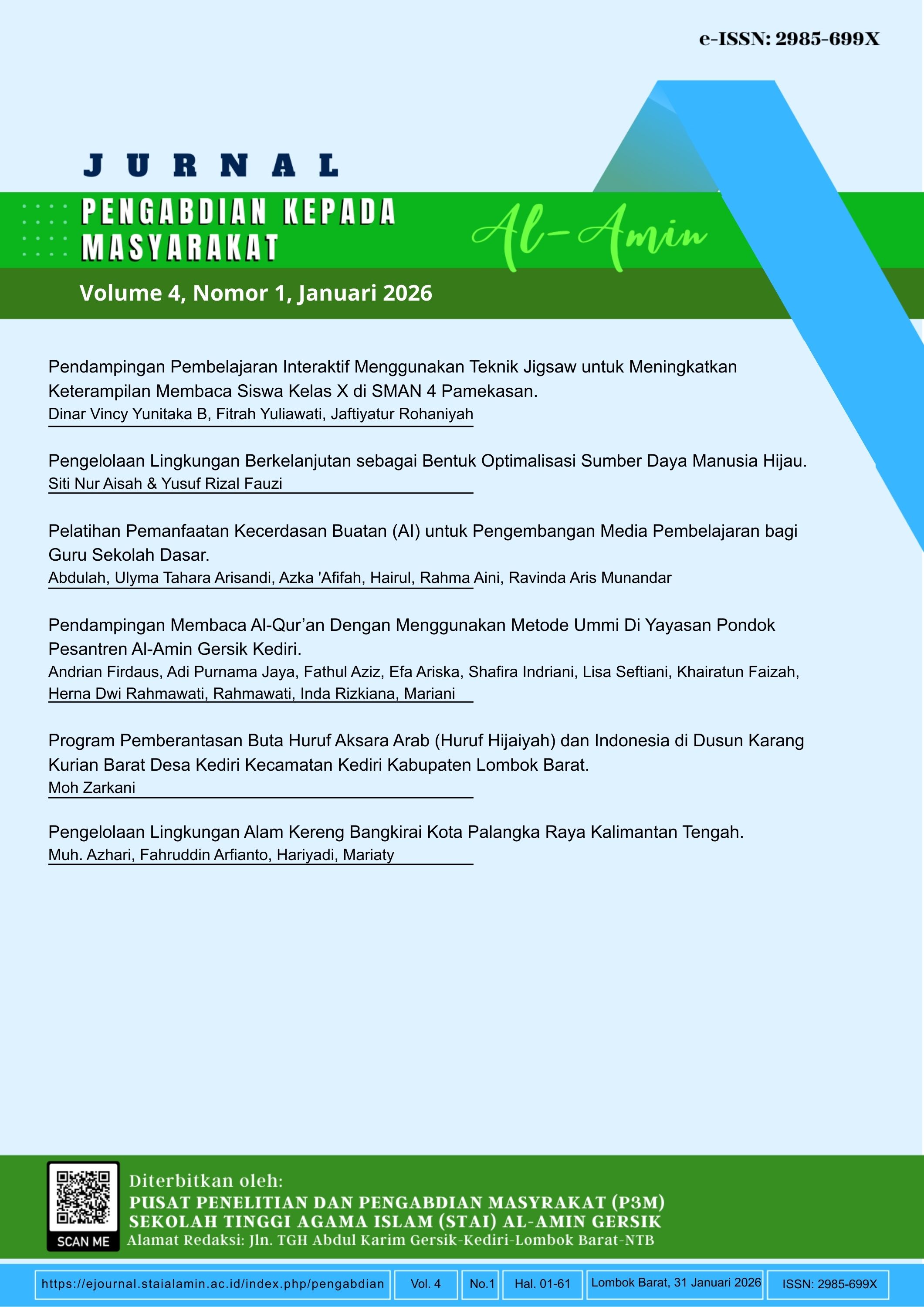
Program to Eradicate Illiteracy in Arabic Script (Hijaiyah) and Indonesian Script in Karang Kurian Barat Hamlet, Kediri Village, Kediri Subdistrict, West Lombok Regency
DOI:
https://doi.org/10.54723/jpa.v4i1.26Keywords:
eradication program, arabic literacy (hijaiyah letters), and indonesiaAbstract
This service aims to make the people of Karang Kuripan Barat Hamlet, Kediri Village, Kediri District, West Lombok Regency 'literate' in Indonesian and Arabic. The community is expected to be able to read the Indonesian language well so that they can quickly obtain information related to regional potentials through various articles, books, and other sources. As a medium for understanding the religion of teaching Arabic, in this case, learning to read the Holy Qur'an is an obligation for the people of Molantadu Village, who are 100% Muslim. This service activity applies different learning methods adapted to the objectives of each exercise. Eradication of Indonesian and Arabic scripts using the Iqra method is "door-to-door teacher." With this method, it is hoped that people aged 30-50 years who are illiterate in Indonesia are not ashamed to learn because of their age, and the places and friends to study are only their neighbors. The Indonesian literacy method is "reading with punctuation." In this activity, children of primary school grades 4, 5, and 6 will be taught Indonesian according to their learning needs but using a variety of fast and easy learning methods as well as fun learning media related to the topic of using 'punctuation' properly and correctly. Arabic literacy will use the "IQRA" method. This method is easier to use for learning to read Arabic because the syllables used for letter recognition are in Indonesian. So, everyone who reads Indonesian fluently will find it easy to learn to read Arabic using this method. This Arabic literacy activity has collaborated with the local Al-Quran Study Center (TPQ). With these different learning methods, the study service participants will be able to face every level of society as good partners when they return to their respective villages. Also, with a Dasawisma-based system, namely learning in groups according to Dasawisma residents or per ten households for each group. This has facilitated program implementation and can directly contact program targets.
References
Badan Pusat Statistik (BPS) Desa Kediri Kabupaten Lombok Barat. 2022. Penduduk Akhir Tahun 2022 Kecamatan Kediri.BPS Kabupaten Lombok barat.
Direktorat Pendidikan Masyarakat, Dirjen Pendidikan Luar Sekolah, Departemen Pendidikan Nasional. 2006. Pedoman Pelaksanaan: Gerakan Nasional Percepatan Penuntasan Wajib Belajar Pendidikan Dasar Sembilan Tahun dan Pemberantasan Buta Aksara. Jakarta.
Djudju Sudjana. 2006. Evaluasi Program Pendidikan Luar Sekolah. Bandung: PT Remaja Rosdakarya. H.B. Sutopo. 2002. Metodologi Penelitian Kualitatif Dasar Teori dan Terapannya dalam Penelitian. Surakarta: UNS Press.
Hadari Nawawi. 2005. Manajemen Strategik Organisasi Non-Profit Bidang Pemerintahan (dengan Ilustrasi di Bidang Pendidikan). Yogyakarta: Gadjah Mada University Press.
J. Salusu. 1998. Pengembangan Keputusan Strategik untuk Organisasi Publik dan Organisasi NonProfit. Jakarta: PT. Gramedia.
Moh. Nazir. 1988. Metode Penelitian. Jakarta: Ghalia Indonesia.
Pariata Westra.1983. Manajemen Pembangunan Daerah. Jakarta: Ghalia Indonesia.